
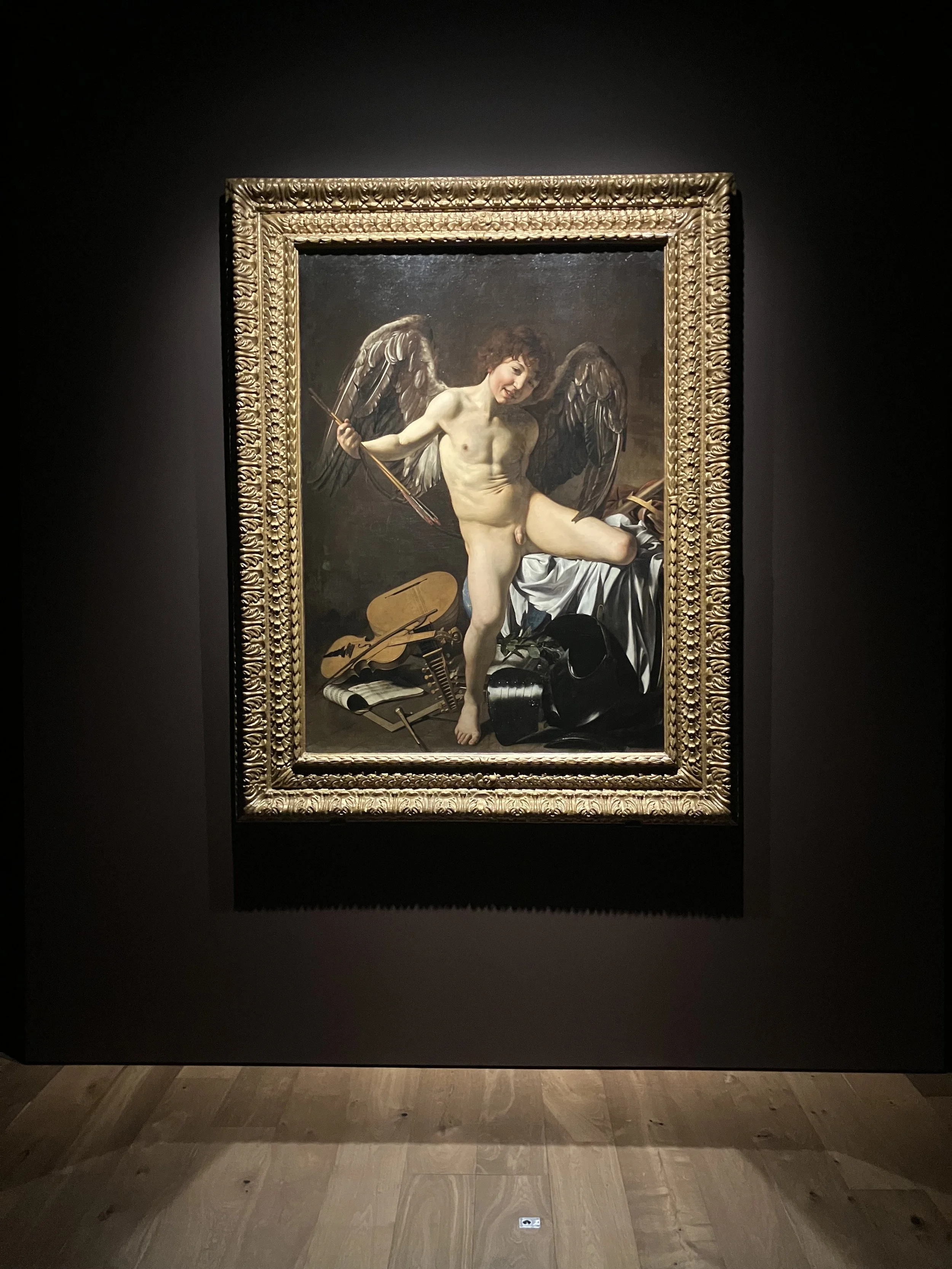
It’s been a wee while since I’ve written an exhibition review, so an exhibition focussing on only one painting seemed like a good chance to “get my eye in” again with a quick write-up and review. It turned out, however, that the Wallace Collection’s exhibition on Caravaggio’s famous painting, the Victorious Cupid, known in Latin as Amor Vincit Omnia (‘Love Conquers All’), was a meatier affair than I initially gave it credit for, taking place over several rooms and with a good dollop of curatorial content.
I should begin by saying that, although I have a great appreciation for his pictures and the innovative style of chiaroscuro (known as tenebrism) which he pioneered, I am no expert on Caravaggio. Indeed, alongside the painting, another reason I was so keen on visiting the exhibition was due to the fact that the Cupid was to be shown alongside several antique sculptures, which is closer to my main area of expertise. It turned out, however, that the sculpture is really just an entrée before the main course of Caravaggio.
The first two rooms of the exhibition set the scene for the unveiling of the painting in the third room. In the first room, we are given biographies of the two main protagonists at the heart of the story; the painter himself, Michelangelo Merisi da Caravaggio (1571-1610), who was born in Lombardy in 1572 and made his way to Rome in 1592 after four years training in Milan; and his patron, the Marchese Vincenzo Giustiniani (1564-1637), a wealthy and erudite Genovese banker and nobleman who lived in his family’s palazzo in the centre of Rome, where he displayed his burgeoning collection of antiquities and modern pictures. In this first room Caravaggio’s Rome around the turn of the seventeenth century is described as a place of contradictions, where grand palazzi and piazzas were surrounded by seedy alleys filled with artists studios, taverns and brothels, where a circle of gamblers and aggressive swordsmen, including the headstrong and proud Caravaggio, would frequently quarrel with one another.
The painting, displayed at the end of this long room, however, is a magnificent sight. Painted in 1601-02 when Caravaggio was at the height of his painterly powers, here the artist is grappling with how to convey complex allegory on canvas. There is plenty of hidden meaning to unpick in this strangely composed painting of a nude and proudly grinning young Cupid, which is presumed to be a portrait of Caravaggio’s studio assistant and lover, Cecco del Caravaggio. The Cupid sits on a draped table, large eagle-like wings on his back and holding two arrows: one gold-tipped, for love requited, the other black-tipped, for love scorned. Underneath his twisting torso sits a celestial globe with musical instruments, laurel leaves and armour representing the various arts and war, which are defeated by love. It is likely that the allegory appealed to Caravaggio’s erudite patron, Vincenzo Giustiniani, who would have enjoyed deciphering the imagery.
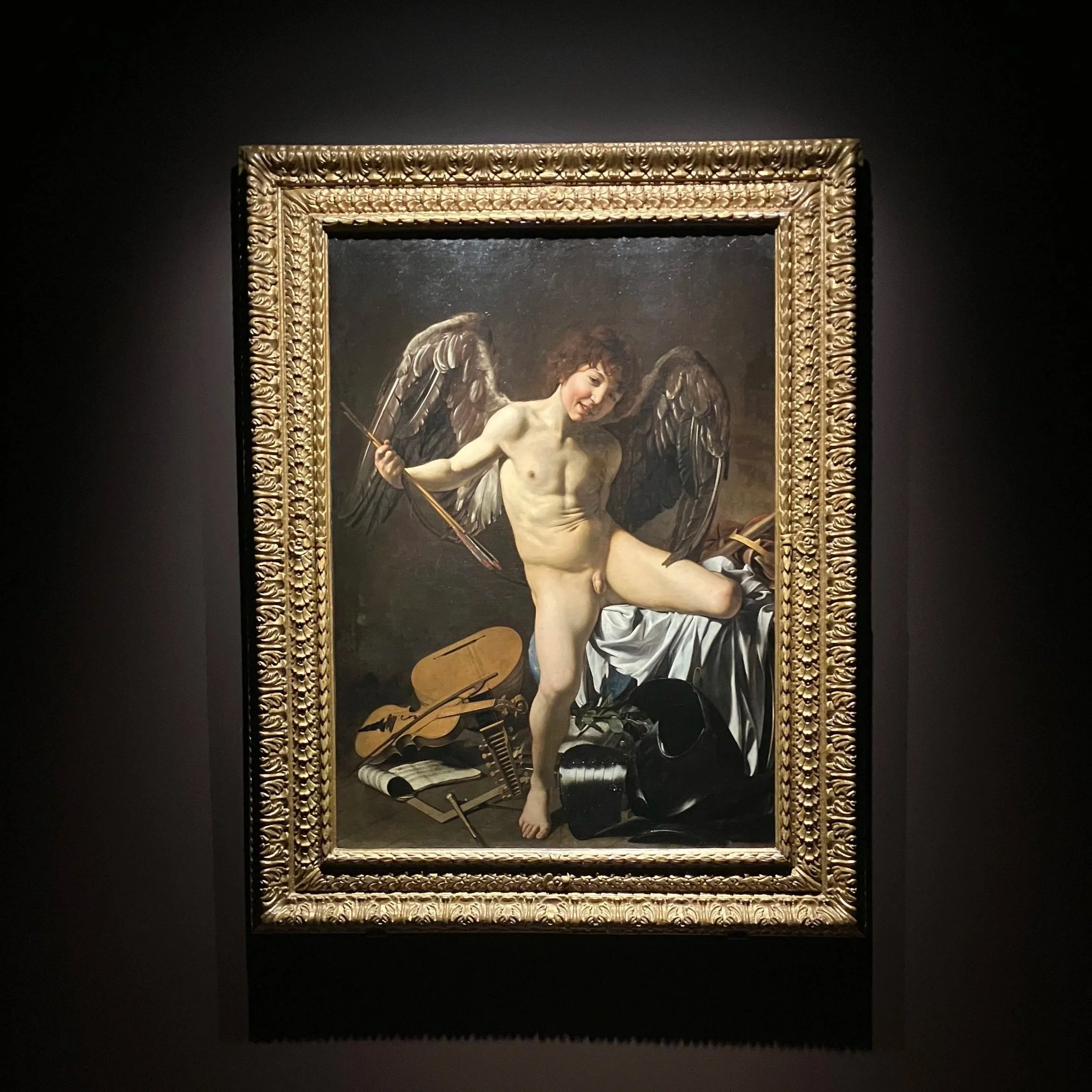
To the side of the main room, two ante-rooms look at the two main sources of inspiration for Caravaggio’s Cupid; firstly, antique sculpture and the Renaissance canons of Raphael and Michelangelo, and secondly, drawing from nature. Caravaggio publicly decried the former, arguing that ‘Nature had sufficiently provided me with masters’. The curators in this exhibition, however, maintain quite persuasively that he was in fact heavily indebted to antique and Renaissance models for his superb drawing of the human form, as is evident in the torso of the Cupid, and that he ‘drank from the fountain of antiquity’.
The final question I wanted to answer when leaving the exhibition was: why was the Wallace Collection holding an exhibition focussing on a painting which is in the collection of the Gemäldegalerie in Berlin? On the front caption outside of the exhibition entrance it mentions that it is part of a “cultural exchange” between the two institutions. Perhaps the Wallace collection loaned the Berlin museum some pictures recently and this was their reward? If so, it was a good idea by the curators at the Wallace Collection and one we’ll hopefully see happening more often. Although, if I owned the Cupid, I wouldn’t want to see him flying off too often.
This post is an excerpt from Sam’s blog; to read the full post, click here: https://samporterart.wordpress.com/2025/12/03/caravaggios-cupid-comes-to-london/